
Robert Nighthawk, Helena, Arkansas, 1942
"My mother often sit down and talk with me, talk with me about being so wild
Well and she said I'm scared that woman and whiskey is coin' to be the ruin of my only child"
The years between 1937 and 1940 were Robert Nighthawk's busiest on record. In addition to cutting 25 tracks under his own name he was in constant demand as a session musician. He can be found on approximately 80 or so sides playing with a variety of different musicians. It should be noted that there is some speculation that Nighthawk may not be the harmonica player on all the sides attributed to him in blues discographies.
Nighthawk's recording career started in 1936 after he left the South and settled into the vibrant music scene of St. Louis. Henry Townsend recalled that Nighthawk was staying in St. Louis most of the time between 1936 and 1939. In addition to Townsend, St. Louis boasted such bluesman as Big Joe Williams, Peetie Wheatstraw, Walter Davis and Sonny Boy Williamson. "Nighthawk was a loner", but Sonny Boy and Townsend became good friends.23 Townsend and Williams were both under contract for Bluebird and it is through them that Nighthawk likely got his break. Townsend says he drove Sonny Boy, Nighthawk, Walter Davis and Big Joe to Aurora, Illinois, in his 1930 A Model Ford for their 1937 sessions: "I transferred them to Aurora, Illinois. There was about eight or nine of us …we stacked them in the car like sardines."23 This led to a marathon recording session resulting in six songs by Nighthawk, six by Sonny Boy Williamson, four by Big Joe Williams and eight sides by Walter Davis. It was Sonny Boy's songs, especially, "Good Morning Little School Girl", "Bluebird Blues" and "Sugar Mama Blues" which were the biggest hits but Nighthawk obviously impressed blues producer Lester Melrose as a talented guitar player and harmonica accompanist. Between 1937 and 1940 Nighthawk commuted regularly between St. Louis and the Bluebird studio in Chicago recording as a session musician and on his own. Nighthawk did session work for the Decca label as well.

Sonny Boy Williamson I
Back in St. Louis, Nighthawk spent time playing with Sonny Boy and Henry Townsend often performing at Ernest Walker's tavern on Jefferson Avenue where they all met Robert Johnson. They were all deeply impressed with his music. Johnson left abruptly and then Nighthawk moved to Chicago in late 1938.23 Fred Utley, Sonny Boy's Uncle describes the atmosphere at one of Sonny Boy's gigs: "The place was full and the people just stood up in the chairs tryin' to see Sonny Boy." Sonny Boy's half-brother further explains: "Guys was followin' Sonny Boy like people was followin' Christ."23
While Nighthawk played guitar on all his own recordings he played quite a bit of harmonica as an accompanist. "Well, I liked that (the harmonica) back in '24...youngster—name a Jones, he's out a Louisiana, named Johnny Jones, and he learned me to blow harp."12 He played harmonica on record up until 1941 when he apparently gave up the instrument to focus on guitar. It was about this time that Nighthawk began mastering the electric guitar and perhaps this is why he abandoned the harp.
The following comes from the book The Chicago Blues of Joe & Charlie McCoy by Guido van Rijn with input from Klaus Kilian: "Although much better known as a slide guitar player, Robert Lee McCoy was an excellent, often virtuoso harmonica player with a distinctive, instantly recognizable style. He learned harmonica in 1924 from a boy called Johnny Jones, but living in Memphis he must have been influenced by Will Shade and Noah Lewis. By the time he recorded on harmonica, the influence of John Lee 'Sonny Boy' Williamson was inescapable, but McCoy was his own man, with an individual approach and unique trademark licks. Considering his proficiency, it is surprising that he only recorded on harmonica as an accompanist, and only until 1941..."
The main characteristics of Robert Lee McCoy's harmonica playing are: 1) Precise, fast final notes, achieved by puckering his lips (as opposed to tongue blocking), quick switches between draw and blow notes, and fast sideways movements between neighboring holes on the instrument. 2) Playing in second position (cross harp) on a diatonic harmonica (e.g. Hohner Marine Band) on all of his recordings. 3) Little use of two or three note chords, concentrating instead on single notes. 4) Often aiming for a very clean sound, as if imitating a trumpet; his use of higher pitched F harmonica on his first session with Joe McCoy emphasizes this.46

Studio log from Sonny Boy's Dec. 17, 1938 session
In addition to his recordings with Sonny Boy and Big Joe, Nighthawk also accompanied the following artists: Baby Doo, Lee Brown, Walter Davis, Sleepy John Estes, Gene Gilmore, Willie Hatcher, Joe McCoy, Jack Newman, Ann Sortier, Speckled Red, Henry Townsend, Walter Vincson and Peetie Wheatstraw. Most of these recordings are available on CD.
In an article on Rhythm Willie for Blues & Rhythm magazine, writer Scott Dirks writes: "Most of Willie's appearances as an accompanist on the recordings of other blues artists are attributed to 'unknown harmonica' or 'possibly Lee McCoy' in published discographies (a situation which this article will examine and attempt to rectify.)."45 Read the full article on the Sources/Articles page.
Jack Newman · October 23, 1936
Robert Lee McCoy — Guitar
Big House Blues (unissued)
Down and Mistreated Blues (unissued)
Pepper Mama (unissued)
That Jive You Got (unissued)
Walter Davis · May 5, 1937
Henry Townsend and Robert Lee McCoy — Possibly guitar, Second vocal -1 "Good Gal"
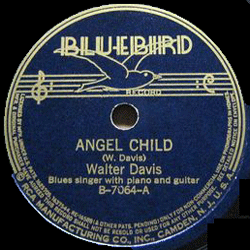
Angel Child · Fifth Avenue Blues · I Ain't Got No Changing Clothes · West Coast Blues
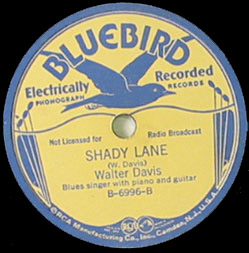
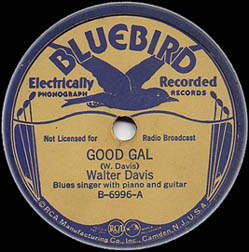
Shady Lane · What Else Can I Do · Nightmare Blues · Good Gal -1
Walter Davis: Vol.2 1935–1937 (Document Records DOCD-5282)
Walter Davis: Vol.3 1937–1938 (Document Records DOCD-5283)
Big Joe Williams · May 5, 1937
Robert Lee McCoy — Guitar
Sonny Boy Williamson — Harmonica
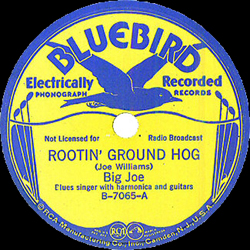
I Know You Gonna Miss Me · Rootin' Ground Hog · Brother James · I Won't Be In Hard Luck No More
Big Joe Williams: Vol. 1 1935–1941 (BDCD-6003)
Sonny Boy Williamson · May 5, 1937
Robert Lee McCoy and Big Joe Williams — Guitar
Good Morning Little School Girl · Bluebird Blues · Jackson Blues
Got The Bottle Up And Gone · Sugar Mama Blues · Skinny Woman
Sonny Boy Williamson: Vol. 1 1937–1939 (DOCD 5055)
Sonny Boy Williamson: Bluebird Recordings (RCA)
Sonny Boy Williamson: Sugar Mama (IGOCD 2014)
The Original Sonny Boy Williamson Vol. 1 (IJSP 77101)
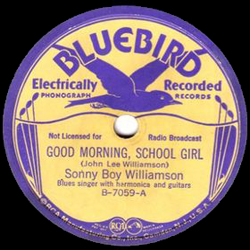
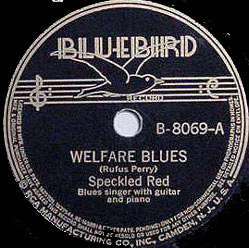
Sonny Boy Williamson · November 11, 1937
Robert Lee McCoy — Guitar
Henry Townsend — Piano -1, Guitar -2
Up the Country Blues -1 · Worried Me Blues · Black Gal Blues -2 · Collector Man Blues -1
Frigidaire Blues · Suzanna Blues -2 · Early in the Morning -2
Sonny Boy Williamson: Vol. 1 1937–1939 (DOCD 5055)
The Original Sonny Boy Williamson Vol. 1 (IJSP 77101)
Speckled Red · December 17, 1938
Robert Lee McCoy — Guitar
Willie Hatcher — Mandolin
Sonny Boy Williamson — Harmonica -1
Welfare Blues · Down On The Levee · Do The Georgia · Early In The Morning
Take It Easy · Try Me One More Time · Louise Baltimore Blues · What Makes You Treat Me Mean?
St. Louis Stomp · You Got to Fix it -1
Speckled Red: 1929–1938 (Document Records DOCD-5205)
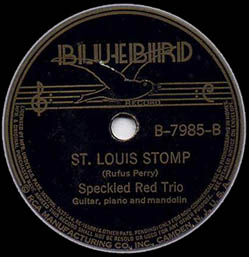
Sonny Boy Williamson · December 17, 1938
Robert Lee McCoy — Guitar
Speckled Red — Piano
Number Five Blues · Christmas Morning Blues · Suzie-Q · Blue Bird Blues · Little Girl Blues
Low Down Ways · Goodbye Red · The Right Kind of Life · Insurance Man Blues · Rainy Day Blues
Sonny Boy Williamson: Vol. 2 1938–1939 (DOCD-5056)
Willie Hatcher · December 17, 1938
Robert Lee McCoy — Guitar
Speckled Red — Piano
They're Mean To Me · So Unkind
Speckled Red: 1929–1938 (Document Records DOCD-5205)
Lee Brown · September 14, 1939
Robert Lee McCoy or Rhythm Willie — Harmonica
Bill Gaither — Guitar
Unknown Bass -1 and Drums -2
Little Brown Skin -1 · Lock And Key Blues -2 · Treated Like A Dog -2 · My Driving Wheel -2
Lee Brown: 1937–1940 (Document Records DOCD 5344)
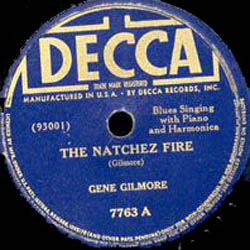
Gene Gilmore & Baby Doo · June 4, 1940
Robert Lee McCoy — Probably Harmonica
Baby "Doo" Caston — Piano
The Natchez Fire
Chicago Blues (Document Records DOCD-5444)
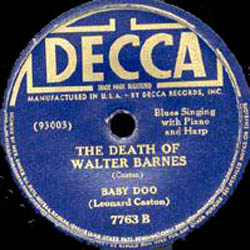
Baby Doo — Vocals · Robert Lee McCoy — Probably Harmonica · Gene Gilmore — Piano
The Death Of Walter Barnes
Chicago Blues Vol 2 1939–1944 (Document Records DOCD-5444)
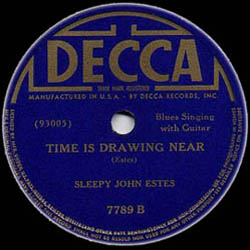
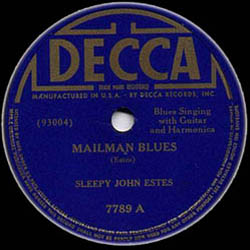
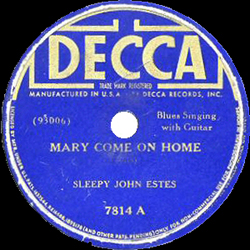
Sleepy John Estes · June 4, 1940
Robert Lee McCoy — Guitar -2, Harmonica -3
Unknown Washboard -4
Mailman Blues -2,3 · Time Is Drawing Near -2 · Mary Come On Home -2
Jailhouse Blues / Tell Me How About It (Mr. Tom's Blues) -1,3,4 · Drop Down (I Don't Feel Welcome Here) -1,3,4
Sleepy John Estes: Vol. 1 1929–1937 (Document Records DOCD-5015)
Sleepy John Estes: Vol. 2 1937–1941 (Document Records DOCD-5016)
Big Joe and His Washboard Band · December 14, 1940
Robert Lee McCoy — Harmonica
Ransom Knowling — Probably Bass
Amanda Sortier — Washboard, Vocal -1
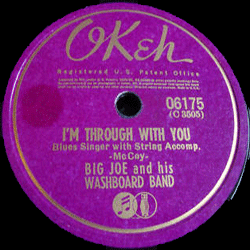
If You Take Me Back · I'm Through With You · When You Say Goodbye · I Love You Baby
Good Time Blues: Harmonicas, Kazoos, Washboards & Cow-Bells (Columbia/Legacy CK 46780)
Big Joe and His Rhythm Band · July 23, 1941
Robert Lee McCoy — Harmonica
Ransom Knowling or Alfred Elkins — Imitation Bass
Amanda Sortier — Washboard
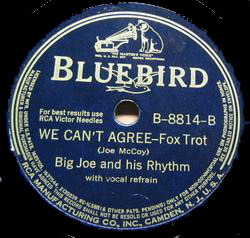
What Will I Do? · Oh Red's Twin Brother · We Can't Agree · Let's Try It Again
Charlie McCoy: The McCoy Brothers: Charlie and Joe McCoy 1934–1944 Vol.2 (Wolf Records RST BDCD-6020)
Walter Vincson · August 1, 1941
Robert Lee McCoy — Harmonica
Alfred Elkins — Imitation Bass
Every Dog Must Have His Day · You Know What You Promised Me · Gulf Coast Bay
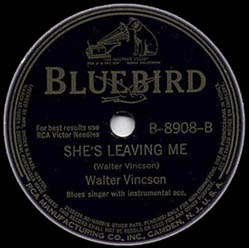
Rosa Lee Blues · Can't Get a Word In Edgewise · She's Leaving Me
Walter Vincson: 1928–1941 (Wolf Records RST BDCD-6017)
Peetie Wheatstraw · March 12, 1941
Robert Lee McCoy — Harmonica
Lil Armstrong — Possibly Piano
I Don't Feel Sleepy · My Little Bit · Seeing Is Believing · The Good Lawd's Children
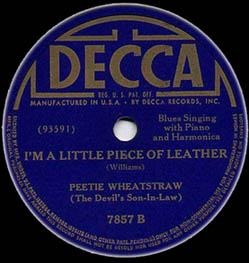
You Got to Tell Me Something · Love Me With Attention · I'm A Little Piece of Leather
Peetie Wheatstraw: Vol. 7 1940–1941 (Document Records DOCD-5247)